
E-commerce development
E-commerce built around your catalogue and order workflow
We build online stores around your actual product range and fulfilment workflow. Customers can find and order the right item easily, while your team manages prices, stock, payments, delivery and orders in one place.
What we shape before development
How products are sold
We clarify categories, variants, units, minimum quantities and the rules that affect a purchase.
How orders reach customers
We review the cart, required customer details, payment methods, delivery choices and the way orders are processed.
Who manages the store
Content, service and warehouse responsibilities determine the administration and integrations required.
Core e-commerce components
- Categories, search and product pages
- Variants, quantities and pricing rules
- Cart and checkout
- Agreed payment and delivery integrations
- Order administration, analytics and SEO foundations
A good store serves both shoppers and staff
Product choices should feel simple
A standard item, a size-and-colour variant and a bakery product sold by weight need different controls. Before design, we define variants, units, minimum quantities, extras, pricing and availability.
Checkout should answer the customer’s questions
We agree when an order is created, which details are needed and when the final total appears. The store includes the payment and delivery methods the business actually uses.
From product model to administration
Product model
We structure products, variants, pricing, quantities and the information customers need to choose.
Ordering flow
We prototype product selection, cart and checkout on mobile and desktop.
Administration and connections
We connect the required services and make order handling straightforward for the team.
Inputs that make an estimate reliable
Product structure
We review representative products, variants, prices, quantities, images and categories to design efficient catalogue management.
What happens after an order
We follow the order from receipt through preparation and customer updates, connecting the shopping experience with the team’s work.
Store scope confirmed explicitly
- Product types, variants and pricing rules
- Required customer, cart and order data
- Agreed payment and fulfilment methods
- Administration roles, notifications and order states
A bakery range and ordering flow
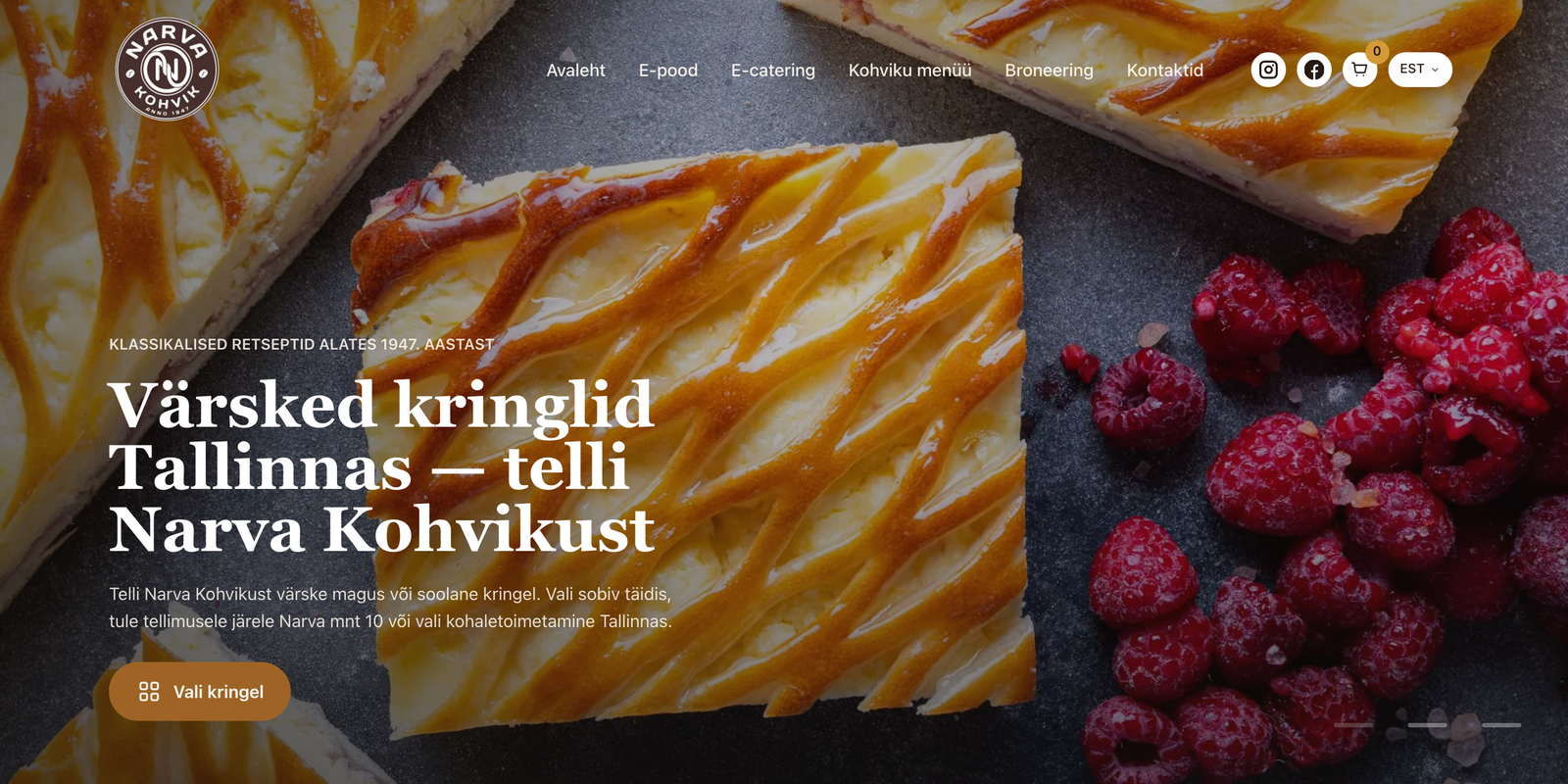
Narva Kohvik lets customers browse categories and products, choose a variant or quantity, review the cart and select delivery or pickup.
Moving products and opening the store
Before opening, we import a small product set and check variants, prices and images. We then place typical orders using the available payment and delivery choices and correct anything unclear. The team receives concise guidance for managing products and orders.
E-commerce development questions
How is the platform selected?
We compare the catalogue, required connections, content management and daily order handling, then choose a platform that will still fit the business after launch.
Can payment and delivery services be connected?
Yes, where the chosen service offers a suitable interface and the scope is agreed. Exact boundaries are confirmed during discovery.
Can existing products be migrated?
Yes, once the source format and data quality are understood. Fields, variants, images and validation rules are mapped before migration.